

Acetic acid is a core input in manufacturing, water treatment, mining, and pharmaceutical intermediates, sitting at the intersection of cost control, compliance, and uptime. For supply chain directors and technical buyers, understanding grades, logistics, and its roles in different industries helps prevent bottlenecks, reduce total cost of ownership, and protect quality across sites in the U.S. and Mexico.
Acetic acid is a high-demand commodity chemical that impacts plant performance, quality specs, and regulatory compliance across multiple verticals. For purchasing managers and operations leaders, the value lies in aligning concentration, grade, and packaging with process needs while ensuring safe handling, stable lead times, and vendor reliability. This updated guide explains properties, sourcing, and the roles in different industries most relevant to technical procurement. Keep reading for concise answers you can lift directly into sourcing specs and SOPs.
What is acetic acid and why does it matter to industrial buyers?
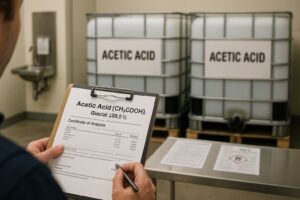
Acetic acid is an organic acid (CH₃COOH) used as a reagent, pH adjuster, descaler, solvent, and precursor. It’s available as glacial (≥99.5%) and lower dilutions. For buyers, it influences corrosion control, product quality, sanitation, and throughput. Matching grade, packaging, and delivery frequency to usage prevents cost and safety issues.
Which industries rely on acetic acid today?
Acetic acid supports continuous operations in water treatment, mining, food and beverage, pharmaceuticals, automotive, pulp and paper, and chemical manufacturing. The same chemical serves different roles in different industries: pH control, cleaning, acetate synthesis, and scale removal. Choosing the correct grade and packaging minimizes waste, improves dosing accuracy, and stabilizes inventories.
Industry snapshot:
| INDUSTRY | TYPICAL USE CASE | COMMON SPECS | BUYER NOTES |
| Water & Wastewater | pH control, alkalinity trimming, odor control | 5–20% aqueous, food/tech grade per site | Lower fuming vs. mineral acids; easier shipping/ventilation in enclosed plants. |
| Mining & Metals | Metal surface prep, scale removal, reagent make-up | 10–30% aqueous, technical | Predictable acidity; compatible with common elastomers; plan for corrosion coupons. |
| Food & Beverage | CIP rinse, antimicrobial steps, flavoring | Glacial for dilution; FCC/food grade | Verify FCC specs, supplier CoAs, and allergen statements; dedicated food-contact packaging. |
| Pharma & Biotech | API/intermediate synthesis, buffer prep | Glacial, GMP documentation | Require batch traceability, impurity profile, and change-control notifications. |
| Automotive & Coatings | Solvent, polymer/acetate synthesis, cleaning | Glacial/technical | Manage VOC reporting; check material compatibility for hoses and seals. |
| Pulp & Paper | pH regulation in bleaching/deinking | 10–20% aqueous | Lower risk of chloride-induced corrosion vs. some alternatives. |
| General Manufacturing | Descaling, cleaning, acetate salts | 10–30% aqueous, technical | Standardize SKUs across sites to simplify procurement and safety training. |
How does acetic acid improve water treatment and metal cleaning?
As a weak acid, acetic acid offers controlled pH adjustment with fewer fumes than many mineral acids. In water systems, it stabilizes treatment windows; in metal cleaning, it removes carbonate and oxide scale while reducing chloride-related corrosion risks. Results: smoother dosing, safer work areas, and predictable performance.
Key advantages for operations:
- Lower volatility vs. strong acids at comparable corrections; helps ventilation control.
- Effective carbonate scale removal without adding chloride or sulfate load.
- Compatible with common dosing equipment; easy to calibrate in closed-loop systems.
- Reduced risk of over-acidification thanks to its weaker acid profile.
What grades, concentrations, and packaging should buyers compare?
Select between glacial acetic acid (≥99.5%) and pre-diluted grades based on process safety, dilution infrastructure, and accuracy. Packaging ranges from returnable totes to bulk tank deliveries. Align concentration with metering capability and storage rules to minimize on-site dilution, spills, and variability across plants.
Typical purchasing options:
- Grades: Glacial (≥99.5%); Technical; FCC/Food; Pharma-supporting documentation (GMP alignment); Low-water specs for certain syntheses.
- Concentrations: Glacial; 20–30% for cleaning and metals; 5–10% for water treatment and sanitation.
- Packaging: 55-gal drums, 275–330 gal IBC totes, ISO containers, tank trucks, rail (where available).
- Quality docs: CoA per lot, SDS, impurity profile, allergen and food-contact statements (for FCC), tamper-evident seals.
Quick comparison:
| PARAMETER | GLACIAL (≥99.5%) | PRE-DILUTED (5–30%) |
| Best for | Synthesis, exacting specs, centralized dilution | Sites without dilution capacity; safer handling |
| Pros | Highest purity; flexible | Faster deployment; consistent dosing |
| Cons | Requires careful dilution; higher fuming | Higher freight per acid unit |
| Typical Packaging | Bulk, totes, drums | Totes, drums |
How does acetic acid compare with other commonly used acids?
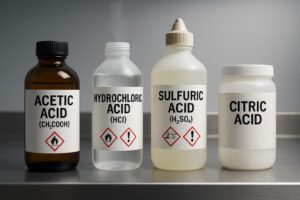
Compared with hydrochloric and sulfuric acids, acetic acid provides gentler pH control, less corrosive vapor, and simpler ventilation needs. It often reduces chloride/sulfate loading and downstream corrosion risk. While not a replacement in every case, it’s a strong option for descaling, cleaning, and pH trimming where process control and safety matter. Remember, you should always confirm material compatibility and required dose to reach target pH or scale removal.
What regulations and standards apply in the U.S. and Mexico?
Procurement must align with OSHA/GHS labeling, NFPA hazard ratings, SDS access, and correct UN classification for transport. Food and pharma uses require tighter documentation. In Mexico, align with STPS workplace safety norms and SCT transport rules. Ensure local spill response, eyewash stations, and secondary containment match your internal EHS policy.
Compliance checklist:
- Classification & Labeling: GHS labels, NFPA/HMIS hazards on all containers; current SDS.
- Transport: Correct UN number, packaging group, and placards per mode.
- Workplace Safety: PPE policy, eyewash/shower, ventilation, spill kits; training records on file.
- Food/Pharma: FCC or pharma-supporting documentation; CoA with impurity limits; supplier batch traceability.
- Mexico-specific: Alignment with applicable STPS safety norms and SCT transport documentation; Spanish-language SDS and labels available for bilingual sites.
How should acetic acid be stored and handled to reduce risk?
Store acetic acid in cool, ventilated areas away from oxidizers and bases. Use compatible materials (HDPE, certain stainless steels), closed transfer, and secondary containment. Train staff on dilution (always add acid to water), spill response, and first aid. Standardize SOPs across sites to reduce deviations.
For day-to-day control, use closed metering and dosing systems with backflow prevention, and provide ventilation sized for occasional fumes; in enclosed rooms, confirm any required LEL monitoring. Review corrosion exposure for pumps, gaskets, and seals and specify compatible elastomers. Manage temperature to limit vapor formation and protect packaging integrity. Conduct routine inspections of caps, valves, tote cages, and relief vents to catch wear or damage before it becomes a leak or off-spec event.
What should you ask a supplier before issuing a PO?
Confirm grade, concentration, CoA format, and lead times by lane. Validate delivery assets (pump-off, nitrogen pad, seals), emergency response coverage, and change-control notices. Ask about multi-plant stocking, safety data in English/Spanish, and options to standardize SKUs across sites. Align minimum order quantities with your consumption and storage limits.
Buyer’s checklist:
- Grade and assay tolerance (glacial vs. specified dilution)
- CoA parameters (water, aldehydes, iron, color) and batch traceability
- Packaging options and compatibility with your fittings
- Delivery windows, live tracking, and demurrage policies
- Contingency plan for supply disruptions; alternate loading terminals
- Returnable tote programs and cleaning standards
- Local service coverage in the U.S. and Mexico; bilingual support
- Price structure: index formula, freight breakout, and surcharges
Why Acetic Acid Remains Essential Across Industrial Sectors
Acetic acid remains a versatile, controllable acid that supports pH management, scale removal, synthesis, and sanitation across manufacturing, water treatment, mining, and food and pharma production. For multi-site procurement, standardizing concentration, packaging, and documentation reduces risk and spend while improving operational stability and compliance across the roles in different industries your company serves.
Looking for a reliable partner? Choose TZ Group for steady, spec-matched acetic acid, glacial or pre-diluted, delivered on time across the U.S. and Mexico. We align to your forecast, package for your site, and keep pricing competitive. Connect with our team to size the right format, set your delivery cadence, and get a fast, no-nonsense quote.
FAQs
- What is the chemical name in vinegar?
The chemical name for the main component of vinegar is acetic acid, which is also known as ethanoic acid. It is a colorless liquid. - What is acetic acid?
Acetic acid (CH₃COOH) is a colorless, weak organic acid belonging to the carboxylic acid family.
It occurs naturally in vinegar (typically 4–8%) and can be produced biologically or synthetically. - What is acetic acid used for?
Acetic acid has a wide range of applications:
- Food industry: It’s the key component of vinegar, used for flavoring, pickling, and preserving food.
- Chemical manufacturing: It’s used to make vinyl acetate monomer (VAM), acetic anhydride, and esters — essential for plastics, paints, and adhesives.
- Cleaning agent: Diluted acetic acid (vinegar) acts as a natural disinfectant and descaler.
- Pharmaceuticals and textiles: Used as a solvent and in the production of synthetic fibers and medicines.
- Is acetic acid vinegar?
Not exactly. Vinegar contains acetic acid, but they are not the same thing. Vinegar is a solution of acetic acid (about 4–8%) in water, plus trace flavor compounds depending on its source (wine, apple cider, rice, etc.). Pure acetic acid is a concentrated chemical compound, much stronger and not safe to ingest directly.
- What is the formula of acetic acid?
The chemical formula of acetic acid is CH₃COOH (or C₂H₄O₂).
It contains a methyl group (CH₃) bonded to a carboxyl group (COOH) — the defining feature of carboxylic acids. - Is glacial acetic acid pure?
Yes, glacial acetic acid refers to highly concentrated or nearly pure acetic acid (≥99–100%).
It is called “glacial” because it solidifies into ice-like crystals below 16.6 °C (62 °F).
It is corrosive and must be handled with caution.
- What is glacial acetic acid?
Glacial acetic acid is the concentrated, anhydrous form of acetic acid that solidifies at cool temperatures.
It’s called “glacial” because of its ice-like crystals when it freezes.
This form is used in chemical synthesis, laboratory work, and industry..
