

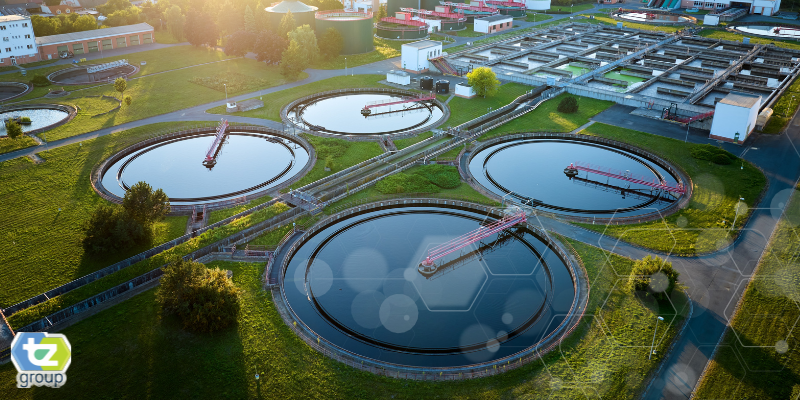
Ferric sulfate improves industrial wastewater treatment by supporting coagulation, phosphorus removal, and more stable solids separation in systems that depend on consistent water treatment performance. It remains one of the treatment chemicals most closely tied to operational control, discharge quality, and process reliability.
Industrial wastewater treatment depends on chemistry that can support compliance, settling performance, and day to day process stability, and ferric sulfate is one of the most established options for that role. This matters since coagulant selection affects sludge behavior, phosphorus reduction, feed control, and supplier risk across the full treatment operation. Keep reading to learn more.
What is ferric sulfate
It’s an iron based coagulant with the formula Fe2(SO4)3. ferric sulfate is used in water treatment to destabilize suspended particles, form floc, and support phosphorus removal by shifting contaminants into a solid phase that can be separated.
What chemical composition and properties define the coagulant
It is a yellowish material that is soluble in water and valued for forming ferric hydroxide floc, and its reactions take place favorably over pH 3.5 to 9.0 when conditions are properly managed.
Dose, wastewater characteristics, chemical addition point, and reaction pH are critical design and economic variables in chemical phosphorus removal. Those variables explain why the same chemistry can perform very differently from one plant to another.
Why is it widely used in water treatment
It supports coagulation and flocculation, phosphorus removal, turbidity control, and in some industrial wastewater applications heavy metal precipitation. It is also linked to color and odor control, which broadens its role beyond simple clarification.
How ferric sulfate works in wastewater treatment
It works by creating ferric hydroxide floc and by reacting with phosphate so pollutants move into a separable solid phase. That is why it’s used where suspended solids and nutrient control must be handled in the same treatment train.
Coagulation and flocculation mechanisms
Coagulation starts with rapid mixing at the dosage point so the iron chemistry contacts target species quickly. Flocculation follows with slower mixing that allows fine particles and precipitates to agglomerate into larger flocs that can settle or be filtered.
Rapid mixing at the point of chemical dosage is critical for efficient phosphorus removal using iron salts, and that uniform dispersion is needed to ensure precipitate formation. After that, slow mixing is needed to build floc size and support solids separation.
Removal of phosphorus and suspended solids
It removes suspended solids by binding small particles into larger flocs. It also separates phosphorus through metal salt precipitation, which transfers phosphate into solids that can then be removed by clarification, sludge handling, or filtration.
Jar testing is commonly used to compare dose, pH range, and mixing speed before full scale operation. There is no single dosage rule that can be applied responsibly across all wastewater types.
What industrial applications make it relevant
The strongest source backed applications are municipal wastewater plants, mining related industrial wastewater, and industrial manufacturing effluents. In all three, the common drivers are solids removal, phosphorus control, and the need for dependable treatment chemicals that fit plant hydraulics and permit targets.
Municipal wastewater plants
Municipal plants use ferric sulfate as phosphorus removal is often required and metal salt precipitation is a standard approach. Many treatment plants remove phosphorus by adding chemicals to precipitate phosphate and then separating the solids, and ferric salts are a standard phosphate control method.
Mining wastewater treatment
Mining wastewater requires treatment chemistry that can help remove suspended solids and support the precipitation of dissolved metals. In this context, ferric sulfate can be a practical option when process conditions such as pH, dose, feed point, and mixing are properly evaluated. Since wastewater characteristics vary from one stream to another, performance should be confirmed through testing rather than assumed across all mining applications.
Industrial manufacturing effluents
Industrial manufacturing effluents need treatment chemicals that can remove suspended matter and support nutrient control without an overly narrow operating window. Phosphate, nitrogen compounds, and organics in reused secondary effluent can support microbiological growth and fouling in industrial systems if they are not removed upstream.
What are the advantages over other coagulants
The clearest advantages are better settling behavior, effective phosphorus control, and broader operating flexibility. Ferric sulfate can form denser floc than alum and can perform across a wider pH range, while metal salts can also avoid the higher sludge generation and pH adjustment demands associated with lime based treatment.
Better sludge settling
Ferric sulfate forms ferric hydroxide floc with higher density than alum flocs and that those flocs are more easily or quickly removed by sedimentation. For operations, that’s the most direct source backed reason to expect stronger settling behavior.
Efficient phosphorus removal
It’s effective for phosphorus removal because iron salts react with soluble phosphorus and move phosphate into a solid phase that can then be separated from the water. Ferric sulfate and ferric chloride are standard chemicals for phosphate precipitation in wastewater treatment.
Reduced chemical consumption
Ferric sulfate can help reduce related chemical demand when its operating range lowers the need for additional pH correction compared with treatment approaches that depend on more aggressive adjustment. In phosphorus removal programs, this can simplify chemical control and reduce the need for downstream neutralization.
| DECISION FACTOR | FERRIC SULFATE | ALUM | LIME |
| Reaction range | Favorable over
pH 3.5 to 9.0 |
May need excess to depress pH to an optimal environment | Depends on high pH and later neutralization |
| Settling profile | Dense ferric hydroxide floc | Alum sludge may be harder to thicken and dewater than iron sludge | Poor settleable floc can occur when alkalinity is low |
| Sludge load | Metal salts avoid the sludge increase linked to lime | Metal salts avoid the sludge increase linked to lime | Substantial increase in sludge mass |
| Control basis | Dose and testing | Dose and testing | Target pH range |
Environmental and Regulatory Considerations
EPA identifies nutrient pollution as one of the most widespread and challenging environmental problems, driven largely by excess nitrogen and phosphorus. They also explain that too much phosphorus can intensify algal blooms, degrade water quality, and reduce oxygen needed by aquatic life.
That context matters since wastewater contains nitrogen and phosphorus, and once discharged it can become a source of nutrient pollution if not adequately treated. For compliance officers, ferric sulfate belongs in the discussion because phosphorus removal is tied to water quality expectations and discharge performance.
Why do operational controls decide results
EPA adds that success in chemical phosphorus removal depends on dose, wastewater characteristics, feed point, reaction pH, and mixing conditions. Ferric sulfate requires careful handling, and EPA provides specific feed system guidance for ferric sulfate solution preparation.
How do you choose a reliable ferric sulfate supplier for industrial wastewater treatment
A reliable supplier should support consistent product quality, suitable delivery formats, and technical support tied to the treatment process. Ferric sulfate performance depends on application control, not just on purchasing the right name on a drum or tank truck.
If your team needs a dependable source of ferric sulfate and other treatment chemicals, we are your greatest ally. TZ Group supports customers with distribution, technical support, inventory management, and coverage across the US and Mexico. TZ Group helps you build a stronger, more reliable water treatment operation, contact us today.
